The word caught my eye before the book did.
Risking.
Risk has always intrigued me. It still does.
These days, I’m taking a different kind of risk. I’m writing a book. Writing one is hard enough. Publishing it—and urging individuals to read it—requires another level of commitment. There is time, uncertainty, the possibility of rejection, and, in my case, a financial investment approaching $20,000.
And I’m still taking chances.
When I spotted Risking by David Viscott, M.D., among the books on my shelves, I remembered it immediately. I hadn’t opened it in years, maybe decades, and I couldn’t wait to skim it again. When I pulled it from the shelf, I noticed the old Waldenbooks price sticker.
$4.50. My risks are more expensive now.
As I began turning the pages, the price no longer held my interest—it was my highlighting.
I bought the book after leaving Fargo-Moorhead and starting a life of my own. Independence was liberating. It was also a little frightening. I was learning that leaving the familiar and knowing what comes next are two entirely different things.
I was looking for some guidance—and there it was in yellow.
I highlighted passages about knowing yourself, about looking inward before looking outward, about change and fear and accepting responsibility for the choices we make.
I wasn’t only rereading David Viscott. I read the reactions of a younger man who first encountered him.
Then I came to Chapter 8, “Risks of Change.”
There were more markings. Viscott wrote about the consequences of waiting too long to change. I had marked his observation that suffering isn’t necessarily wasted if it brings us to some point of resolution. Another passage reminded the reader that risk includes accepting responsibility for the possibility of loss.
And then I found the asterisks.
Viscott wrote that if we don’t ask questions about things we don’t understand, life will become increasingly difficult. That sentence mattered to me. I made sure I wouldn’t miss it or forget it.
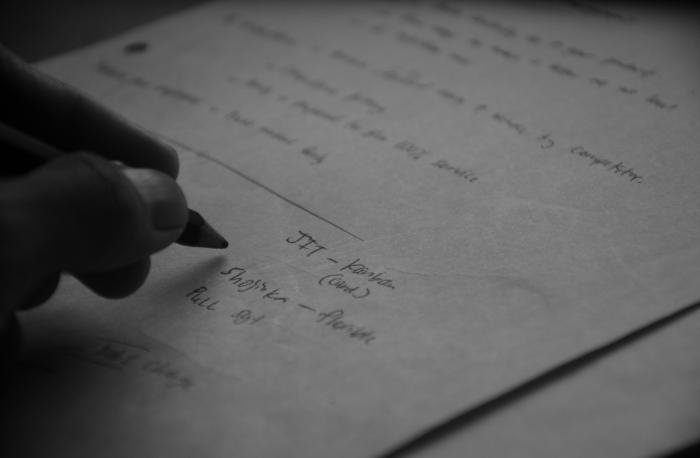
And at the bottom of the page, in my own handwriting, I added:
Mom always told me to shut up.
I pondered that for a while. Judging the sentence or opening again an old grievance didn’t interest me. It was the young man who wrote it. He had no idea where his life headed.
He didn’t know that he would spend much of his career as a pharmacist, in a profession where asking questions isn’t a nuisance. Sometimes it is essential. A question can uncover a misunderstanding, prevent an error, or help someone use a medication safely.
He certainly didn’t know that decades later he would be writing a book encouraging patients and caregivers to ask questions when they don’t understand something about their healthcare.
And he couldn’t possibly know that I had published an essay called “Any Questions?” only days before pulling Risking from the shelf. But I smiled at that one.
Maybe the risks change as we do.
When I was younger, risk meant leaving familiar surroundings and learning to make my own decisions. Today it can mean submitting an essay, standing in front of an audience, walking into a room where I know almost no one, or investing years of work—and a considerable amount of money—in a book I believe should exist. None of those things comes with a guarantee.
Perhaps that’s why another sentence I highlighted years ago was still familiar. Among Viscott’s dos and don’ts of risking was a simple admonition:
Don’t pretend you’re sure when you’re frightened.
I like that better now than I probably did then. Certainty isn’t a prerequisite for moving forward.
Eventually I stopped reading Risking and started looking at the book itself. The pages were older. The highlighting had aged. The handwriting was definitely mine, although it belonged to a version of me I hadn’t visited in a long time.
And I realized that some old books become accidental journals. We underline what matters to us. We put stars beside sentences. We fold corners. We scribble a thought in a margin or at the bottom of a page. We think we’re marking the author’s words so we can find them again. Maybe we’re leaving something else behind.
Clues.
Not necessarily to what the author thought was important, but to what we needed when we were reading.
David Viscott’s words haven’t changed since I paid $4.50 for them. The reader has.
Maybe somewhere on your shelves is a book you haven’t opened in thirty or forty years. Pull it down sometime.
Perhaps the interesting question isn’t what the author wrote.
It’s what you underlined.